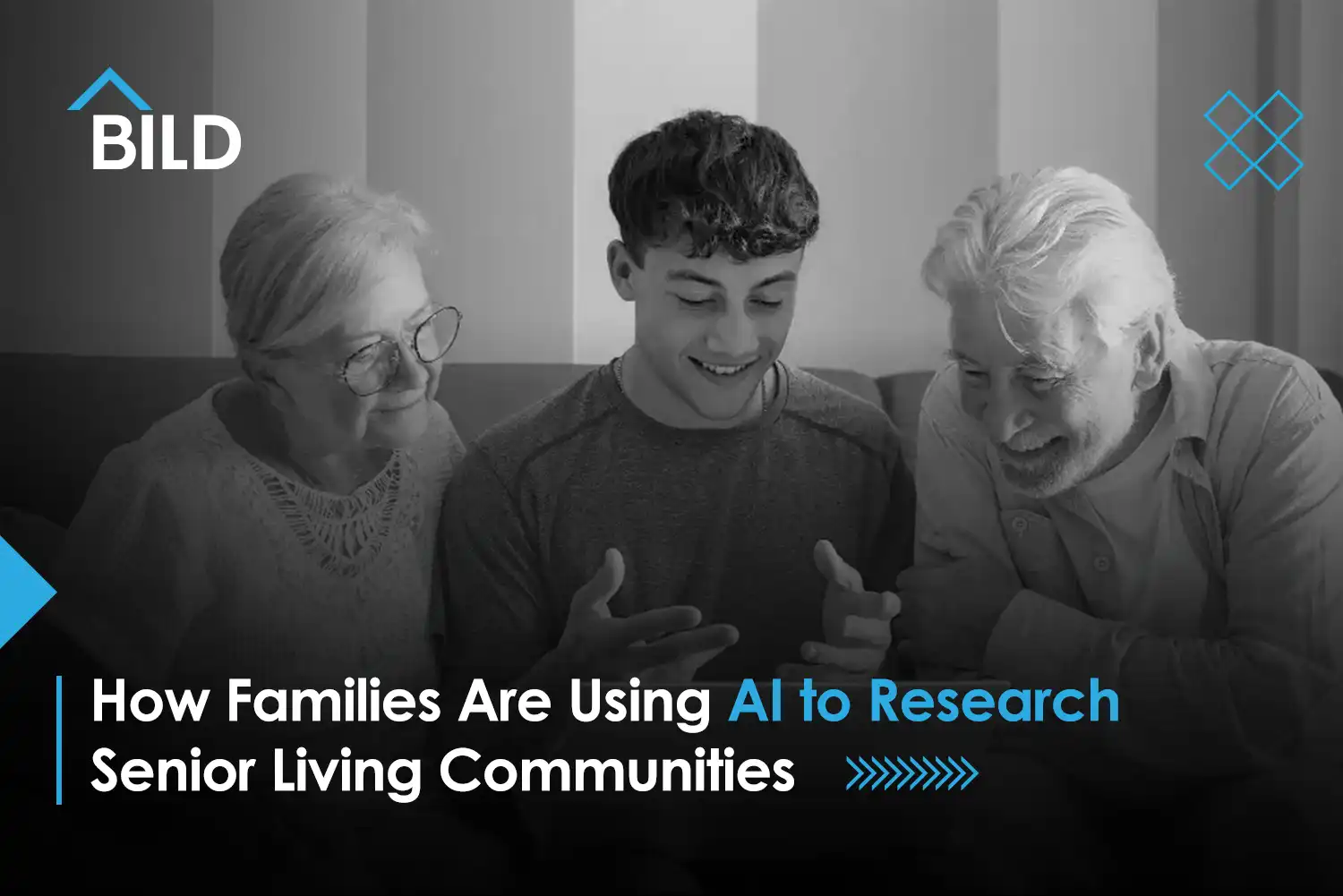
Choosing a senior living community is a major decision for families. Before scheduling a tour or speaking with a community representative, families often spend significant time researching care options, comparing communities, reading reviews, understanding costs, and trying to determine which option will be the right fit for their loved one.
Today, that research process is increasingly taking place through AI-powered search and conversational tools.
Instead of relying only on traditional Google searches, families can ask AI platforms detailed questions such as “What are the best assisted living communities near me?”, “How much does memory care cost?”, or “What should I look for when choosing a senior living community for my parent?”
This shift is creating a new consideration for senior living operators: Is your community’s online presence providing the information families need when they use AI to research senior living?
For communities looking to adapt to this changing search behavior, BILD & Co’s senior living marketing services combine SEO, website development, digital marketing, hyperlocal marketing, branding, and other strategies designed to increase qualified visibility and support occupancy growth.
How AI Is Changing the Senior Living Research Process
Traditionally, a family researching senior living might search Google, open several websites, compare pricing, read reviews, and contact communities individually.
AI can simplify parts of this process by allowing families to ask questions conversationally and receive summarized information.
For example, instead of performing several searches for:
“Assisted living near me”
“Assisted living cost”
“Best assisted living communities”
“Questions to ask an assisted living community”
a family can ask an AI platform:
“I’m looking for an assisted living community near Nashville for my mother. She is mostly independent but needs help with medication and daily activities. What should I look for, and which communities should I compare?”
The question contains location, care needs, preferences, and intent.
This means AI search can potentially influence several stages of the senior living customer journey at once.
For senior living operators, this makes AI search visibility an increasingly important part of the broader digital marketing strategy.
What Are Families Asking AI About Senior Living?
Families are not necessarily asking AI about a community by name.
Many questions begin with the problem they are trying to solve.
For example:
- “When should a parent move into assisted living?”
- “What is the difference between assisted living and memory care?”
- “How much does assisted living cost in Nashville?”
- “What should I ask when touring a senior living community?”
- “What are the best senior living options near me?”
- “How can I compare assisted living communities?”
- “What services should be included in assisted living?”
- “What are signs that a parent needs more support?”
- “What should I know before choosing memory care?”
- “Which senior living communities have good reviews?”
These questions represent valuable senior living search intent.
A community that only optimizes for transactional phrases such as “assisted living near me” may miss the earlier informational searches that influence a family’s eventual decision.
This is why modern senior living marketing needs to address the entire research journey.
Families Are Using AI Before They Contact a Community
One of the most important changes for senior living marketers is that AI can become part of the research process before a family ever visits a community website.
A prospective resident’s family may use AI to understand terminology, compare care levels, create questions for a community tour, estimate potential costs, or identify communities to research further.
This means a senior living community’s first digital interaction with a prospect may no longer be a Google search result or a paid advertisement.
It could be an AI-generated answer.
That answer may influence which communities the family considers.
BILD & Co has specifically discussed this shift in its content on how AI search is changing senior living marketing, highlighting the growing importance of authoritative content and visibility across AI-driven discovery experiences. (bildandco.com)
AI Can Help Families Understand Senior Living Options
Senior living terminology can be confusing, particularly for families navigating the process for the first time.
A family may not initially know the difference between:
Independent Living, Assisted Living, Memory Care, Skilled Nursing, and other care options.
AI can provide explanations in conversational language and help families understand which questions they should investigate further.
This creates an opportunity for senior living communities to publish clear educational resources that answer these questions.
For example, instead of creating content that simply promotes a community, a website can explain:
What is assisted living?
Who is assisted living designed for?
What services are typically provided?
How does assisted living differ from memory care?
What should families consider when comparing communities?
When this information is accurate, useful, and supported by credible expertise, it can help both families and AI systems understand the subject.
Families Are Using AI to Compare Communities
As families move further through the decision-making process, their questions can become more specific.
They may ask:
“Compare assisted living communities in my area based on location, care services, amenities, reviews, and pricing.”
This type of query is particularly important for local senior living operators.
A community needs to have accurate and consistent information across its website and broader online presence so search engines and AI systems can understand what the organization actually offers.
Important information can include:
Location, care levels, services, amenities, pricing information, community features, reviews, contact information, operating details, and differentiators.
Inconsistent information can make it harder for users—and potentially AI systems—to understand the community accurately.
That is why local SEO for senior living communities remains an important part of an AI search strategy.
BILD & Co’s guidance on local SEO for senior living highlights the importance of accurate business information, Google Business Profile optimization, authentic reviews, local content, AEO, GEO, and other local visibility factors. (bildandco.com)
Reviews Are Becoming Even More Important
Families have always relied on reviews when evaluating senior living communities.
AI-powered research makes reputation even more relevant because reviews and third-party information can contribute to a broader understanding of a community.
Families may ask:
“What do people say about this senior living community?”
or:
“Which assisted living communities near me have the best reviews?”
This means senior living operators should not think of reviews simply as a Google Business Profile metric.
Reviews are part of the community’s broader digital reputation.
Authentic reviews can provide evidence about resident experience, staff interactions, communication, dining, activities, cleanliness, and other aspects that families may care about.
However, operators should avoid trying to manufacture positive sentiment.
The strongest approach is to provide an excellent resident and family experience and make it easy for satisfied residents and families to share honest feedback.
AI Makes Helpful Content More Important
Families using AI do not necessarily want a sales pitch.
They want answers.
This creates a significant opportunity for senior living communities to build educational content that addresses real questions.
For example, an article titled:
“What Should I Ask When Touring an Assisted Living Community?”
can provide much more value than a generic promotional article about why a particular community is the best.
Likewise:
“How Much Does Assisted Living Cost?”
can explain the factors that influence pricing without immediately pushing the reader toward a sales conversation.
This type of content supports AEO and GEO because it provides clear answers while building topical depth around senior living.
BILD & Co has also emphasized question-based content, authoritative information, local relevance, and structured content as part of its approach to AI search visibility. (bildandco.com)
Families Are Asking More Specific and Conversational Questions
Traditional keyword research often focuses on short phrases.
AI search is encouraging longer, conversational questions.
Instead of:
“Memory care Nashville”
a family may ask:
“What should I look for in a memory care community in Nashville for someone in the early stages of dementia?”
Instead of:
“Assisted living cost”
they may ask:
“What is the average cost of assisted living and what services are usually included?”
This does not mean short-tail keywords are no longer valuable.
It means senior living marketers should build content that covers both traditional search keywords and natural-language questions.
A strong content strategy can target:
Senior living marketing → Assisted living → Assisted living cost → Care services → Choosing a community → Local senior living → Family questions
This creates a stronger semantic relationship between pages and topics.
GEO Helps Communities Become More Discoverable in AI Search
Generative Engine Optimization, or GEO, focuses on improving how easily AI systems can understand and potentially reference a brand’s information.
For senior living communities, GEO should be connected to the information families are actually researching.
A GEO-focused strategy may include:
Clear service pages + authoritative educational content + local information + reviews + structured information + internal linking + expert content + consistent business information
The objective is not to manipulate AI systems.
It is to create a website and digital presence that clearly demonstrates what the community offers and why families can trust the information.
For a deeper explanation, BILD & Co’s How to Get Your Senior Living Community Recommended by AI Search explores the relationship between AI search, local SEO, AEO, GEO, content, reviews, and senior living visibility. (bildandco.com)
The Importance of E-E-A-T in AI-Driven Senior Living Research
Senior living is a trust-driven industry.
Families want to know that the information they find online is accurate and comes from people who understand senior care.
This makes E-E-A-T—Experience, Expertise, Authoritativeness, and Trustworthiness—particularly important.
A senior living website can demonstrate these signals through experienced authors, leadership profiles, original research, expert commentary, resident stories, case studies, accurate references, transparent business information, and authentic reviews.
Content should also demonstrate firsthand understanding rather than simply rewriting information that already exists elsewhere.
For example, an article about choosing assisted living can become more valuable when it includes insights from experienced senior living professionals about what families commonly overlook during community tours.
This creates content that is useful to people and provides stronger context for search engines and AI systems.
How Senior Living Websites Should Adapt
Senior living websites should be designed around the questions families need answered.
The website should clearly explain the community’s services and care options, while supporting those commercial pages with educational content.
For example, a community’s Assisted Living service page can explain the care model and services available.
A supporting blog can answer:
“How Do I Know When My Parent Needs Assisted Living?”
Another can answer:
“What Questions Should I Ask During an Assisted Living Tour?”
Another can explain:
“What Is Included in Assisted Living Costs?”
These pages can then link naturally back to the assisted living service page.
This creates a content ecosystem rather than a collection of disconnected blog posts.
It also gives families a path from education → consideration → community evaluation → inquiry.
Internal Linking Can Connect the Research Journey
Internal linking should reflect how families actually research senior living.
A blog about AI research can link to educational resources about local SEO and AI search, while relevant commercial content can guide readers toward senior living marketing services.
For example, BILD & Co’s article Why Local SEO Matters for Senior Living Communities provides a natural next resource for readers interested in how local visibility affects senior living discovery. (bildandco.com)
Likewise, How to Calculate Marketing ROI for a Senior Living Community can support readers who want to understand how senior living marketing activity should ultimately connect with qualified leads, tours, move-ins, and revenue. (bildandco.com)
These contextual connections help create a more useful journey for readers while strengthening the topical structure of the website.
What Senior Living Marketers Should Track
AI visibility can be more difficult to measure than traditional organic search because a user may see a community mentioned in an AI answer without clicking directly to the website.
Therefore, operators should not rely on a single metric.
Instead, monitor changes across organic visibility, branded searches, website traffic, qualified inquiries, local search performance, referral sources, engagement, reviews, and ultimately tours and move-ins.
It is also useful to periodically test the questions families are asking AI platforms.
For example, families may ask:
“What are the best assisted living communities in [city]?”
“What should I look for when choosing memory care in [city]?”
“Which senior living communities near [location] have good reviews?”
The goal is not to manipulate results or assume that one AI response represents permanent visibility.
The goal is to understand how your community is being represented and identify gaps in your online information.
AI Search Does Not Replace the Human Decision
Even as AI becomes more involved in senior living research, families still need human reassurance.
Choosing a senior living community involves emotions, trust, personal relationships, care needs, financial considerations, and the experience of visiting the community.
AI can help families narrow their options and understand complex information.
It cannot replace the community tour, conversation with staff, interaction with residents, or personal assessment of whether the environment feels right.
This is why AI visibility should ultimately support the human sales journey rather than replace it.
A strong senior living marketing strategy connects the digital research experience with the real-world community experience.
How BILD & Co Helps Senior Living Communities Adapt to AI Search
The way families research senior living is changing, but the fundamentals of effective marketing remain the same: understand the audience, provide valuable information, build trust, generate qualified demand, and make it easy for families to take the next step.
What is changing is where and how families discover that information.
BILD & Co helps senior living organizations adapt through an integrated approach that includes SEO, website development, digital marketing, paid advertising, hyperlocal marketing, social media, branding, and creative services. Its senior living marketing approach focuses on generating qualified opportunities and connecting marketing performance with occupancy and revenue outcomes. (bildandco.com)
If your community wants to improve visibility across Google, local search, and emerging AI-powered discovery platforms, BILD & Co’s Senior Living Marketing Services can help develop a strategy that connects SEO, content, local visibility, lead generation, and conversion.
For communities looking to understand the wider role of AI, GEO, and AEO in senior living, BILD & Co can also help integrate these emerging search strategies into a broader digital marketing and growth plan.
Frequently Asked Questions About AI and Senior Living Research
How are families using AI to research senior living communities?
Families can use AI to understand senior living options, compare care types, research costs, identify questions to ask during tours, evaluate community features, and discover potential communities in a specific location.
Can AI recommend senior living communities?
AI platforms may provide recommendations or mention communities when responding to relevant questions, but results can vary based on the platform, query, available information, location, and other factors. Communities should focus on maintaining accurate, authoritative, and useful information rather than attempting to manipulate AI recommendations.
How can senior living communities appear in AI search results?
Communities can strengthen their AI search visibility by creating authoritative content, maintaining accurate local information, demonstrating expertise, earning authentic reviews, answering common family questions, improving SEO and local SEO, and developing a clear website structure that helps search systems understand their services and expertise.
Does AI search replace Google for senior living research?
No. AI search is becoming another part of the research journey rather than necessarily replacing traditional search. Families may use Google, AI platforms, maps, review websites, community websites, social media, and personal recommendations at different stages of their decision.
Why is local SEO important for AI-driven senior living searches?
Senior living decisions are highly location-dependent. Families typically want communities within a practical distance from their home or family members. Accurate location information, local content, reviews, business listings, and community-specific information can therefore support both traditional local search and emerging AI discovery.
What type of content should senior living communities create for AI search?
The strongest opportunities are usually questions families genuinely ask. Topics can include senior living costs, assisted living vs. memory care, signs a parent may need additional support, questions to ask during tours, choosing a senior living community, care services, local senior living options, and what families should expect during the transition.
Final Takeaway
Families are no longer relying on a single Google search to research senior living.
They are asking increasingly detailed questions, comparing options, learning about care types, researching costs, reading reviews, and using AI to organize information before contacting communities.
For senior living operators, this means digital marketing needs to evolve with the way families research.
The opportunity is not simply to “rank in AI.”
It is to become a trusted and useful source of information throughout the senior living decision-making journey.
By combining senior living SEO, local SEO, AEO, GEO, authoritative content, E-E-A-T, reviews, and conversion-focused marketing, communities can create a stronger digital presence that helps families discover, understand, and ultimately choose the right senior living option.